
Anthony ("Tony") Graham Quinlan OBE
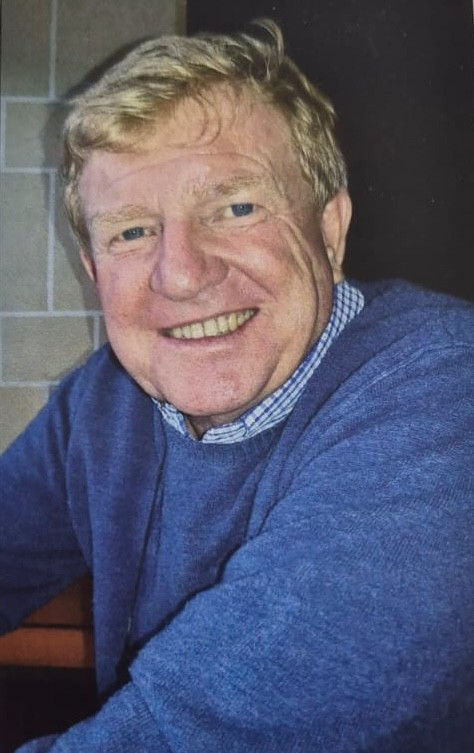
Many will remember Tony Quinlan who worked in the Palace Office in Oman from 1975 to the mid 1980s. Tony and his wife, Nicky, were well known to many in SAF in Northern Oman. Although we never really knew what Tony actually did, Nicky worked for many years in ORD for people such as John McKeown and Richard Lee and latterly in the office of General Tim Creasey. Following Tony's move to Palestine in the 1980s Nicky remained in Oman where she still mainly resides.
Memorial Service
The family are holding a memorial service for Tony in Windsor on Saturday 15 August 2026, the details as follows:
"We will be holding a remembrance mass for Tony on Saturday 15 August at 11.30am at St Edwards Church, 44 Alma Road Windsor SL4 3HJ.
Followed by drinks at Windsor Rugby Club, Home Park SL4 6HX from 1pm."
If anyone wishes to attend please contact saf.business@dudwell.co.uk and we will forward the mobile number that the family have supplied for RSVPs.
There follows the text of an obituary written by a United Nations colleague of Tony:
Anthony (“Tony”) Graham Quinlan OBE, former British diplomat and United Nations official, died on 24 March 2026, surrounded by his loving family, after a long illness bravely borne.
Born in the United Kingdom on 16 February 1945, Tony was the son of Leslie Graham Quinlan, a civil servant in the Foreign Office, and Patricia (née Burns). He was educated at Steyning Grammar School in West Sussex, founded in 1624 for the education of younger sons of titled gentry and civil servants, and went on to follow his father into the Foreign Office.
His early diplomatic career took him to Georgetown, Guyana, in 1968, where he spent two formative years honing his skills. In 1970 he was posted to Tehran, Iran, at a time marked by striking contrasts: rapid, state‑mandated modernisation and a booming oil‑fuelled economy on the one hand, and political repression and deep social inequality on the other. In 1975 he moved to Oman to serve in the Private Office of Sultan Qaboos bin Said.
Life in Oman in the 1970s was characterised by unprecedented, overnight transformation. Following a palace coup in 1970, Sultan Qaboos overthrew his father, who had kept the country in isolation, and set about turning a secluded, quasi‑medieval state into a modern, oil‑rich nation. The Sultan’s Armed Forces, largely officered by British contract personnel, played a central role in quelling the Dhofar Rebellion in the south. Within this context of rapid change, Quinlan was instrumental in establishing the Private Office of the Sultan.
During his time in Oman, Tony met Nicola O’Connell, daughter of an Irish‑born RAF medical officer posted to Malta and his Maltese wife from a prominent local family. Tony and Nicola married and later welcomed two children, Nicholas and Mary‑Kate.
In 1987, as the First Intifada broke out in the Occupied Palestinian Territories, Quinlan joined the United Nations Relief and Works Agency for Palestine Refugees in the Near East (UNRWA). It was a period of intense civil unrest and a heavy security response by the Israeli occupation forces. As casualties rose and increasing numbers of young Palestinians were detained, the international community pressed for a coherent UN response. With the Israeli government opposed to the deployment of a conventional peacekeeping force, arguing that the Geneva Conventions did not apply to the territories, the UN, under Director of Political Affairs Sir Marrack Goulding, devised an alternative. UNRWA field offices in Gaza and the West Bank, including Jerusalem, were reinforced with international staff whose role was to support the agency’s core services—health, education and social work—amid the violence, while circulating through the refugee camps to observe and report on conditions. Their presence provided a measure of passive protection to the civilian population. The initiative became known as the Refugee Affairs Officers Programme (RAO), in which Quinlan played a key part.
For his work in Gaza, Tony Quinlan was appointed OBE by Her Majesty’s Government.
During the First Gulf War of 1991, most international staff were withdrawn from the Occupied Territories, leaving a small stay‑behind team in Gaza and the West Bank to meet the basic needs of the refugees. Quinlan was among the Gaza staff, all billeted in the UN Reporting and Evacuation Centre (UNREC), popularly known as the Beach Club. In this constrained environment he came into his own. A natural storyteller and dedicated opera buff, he organised a series of opera evenings under strict curfew, cutting a distinctive figure in his white tuxedo jacket as he entertained colleagues during the forty nights or the war curfew. At the same time he served as Scud Warden, responsible for staff safety during the Iraqi missile attacks on Israel.

After the war, Quinlan was appointed Operations Officer for the West Bank and Jerusalem, leading the RAO programme there for three successful years before returning to Gaza in a similar capacity. With the outbreak of hostilities in Kosovo, he was later seconded to the UN Mission in Kosovo (UNMIK), where he worked in sensitive Serb‑majority areas, carrying out liaison duties with the various factions.
Following a long international career, Tony retired to Malta. There he indulged his lifelong passion for history and reading, building an impressive personal library in his flat. He was very kind and caring to his aging mother‑in‑law and took great interest in his two adored grandsons, Nicholas and Patrick, sons of Mary‑Kate, and remained actively involved in island affairs, especially Remembrance Sunday and other British community events.
Tony Quinlan is survived by his wife Nicola, his son Nicholas, his daughter Mary‑Kate, his grandsons Nicholas and Patrick, and an extended circle of family and friends who mourn his passing.
A memorial service to celebrate his life will take place at St Edward’s Roman Catholic Church, Windsor, on Saturday 15 August at 11:30.
Tony was a diplomat of exceptional integrity, wisdom and kindness. It was a privilege to have known and worked with him. He will be greatly missed.
Declan Greenway
United Nations Relief and Works Agency, UNRWA
Comments